Unit 5: The
plants
Plants are
living things because they carry out processes such as nutrition (in the roots
and leaves), sensitivity and reproduction (in the flower). These processes
happen in different parts of the plants.
Parts of the plants
Roots are the part underground and some of them are
edible (potato, carrot). Roots can:
1) Make the plant stand
2) Absorb water
Stems support the plant upright above the ground.
Stems carry water through the plant. Stems divides up into branches. Branches
support leaves, flowers and fruits. Stems can be:
1) Herbaceous:
soft and flexible.
2) Woody: hard
and rigid (trunks).
Some plants
have leaves all the year long, they are evergreens;
whereas other plants lose their leaves in autumn, they are deciduous.
Leaves hang from branches by the petiole and in the leaf blade plants make their own
nutrients in a process called “photosynthesis”.
Nutrition in plants
The water
and minerals in the ground are absorbed by the roots (this is called raw sap)
and sent upwards to the leaves where sunlight and carbon dioxide are mixed
resulting in elaborated sap. Elaborated sap goes then all around the plant
giving nutrients to feed all the parts of the plant.
Reproduction in plants
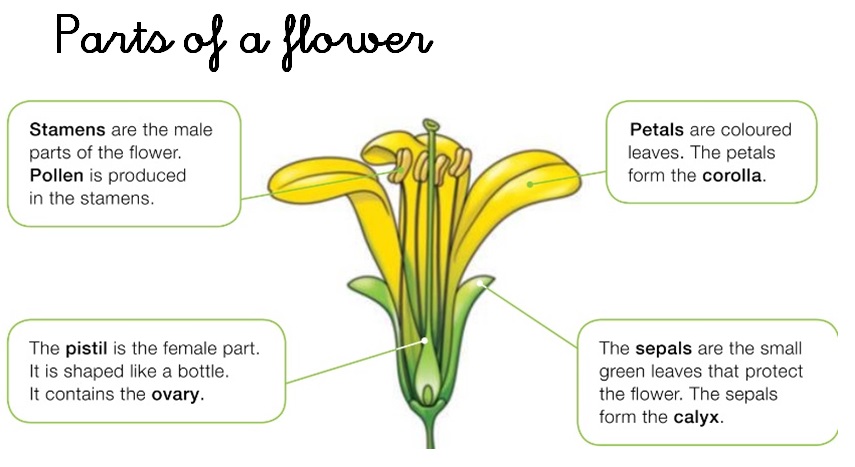
Flowers are
the reproductive organs of plants. In the flower there are different parts that
allow the plant to reproduce:
The process
of reproduction in plants has different steps:
1) Stamens make pollen
2) Pollen gets into the pistil
3) Ovary matures and turns into fruit
(with seeds inside).
4) Seeds fall in the ground and a new
plant grows there.